

The Future of Freelance Work Belongs to People Who Think Like Business Owners

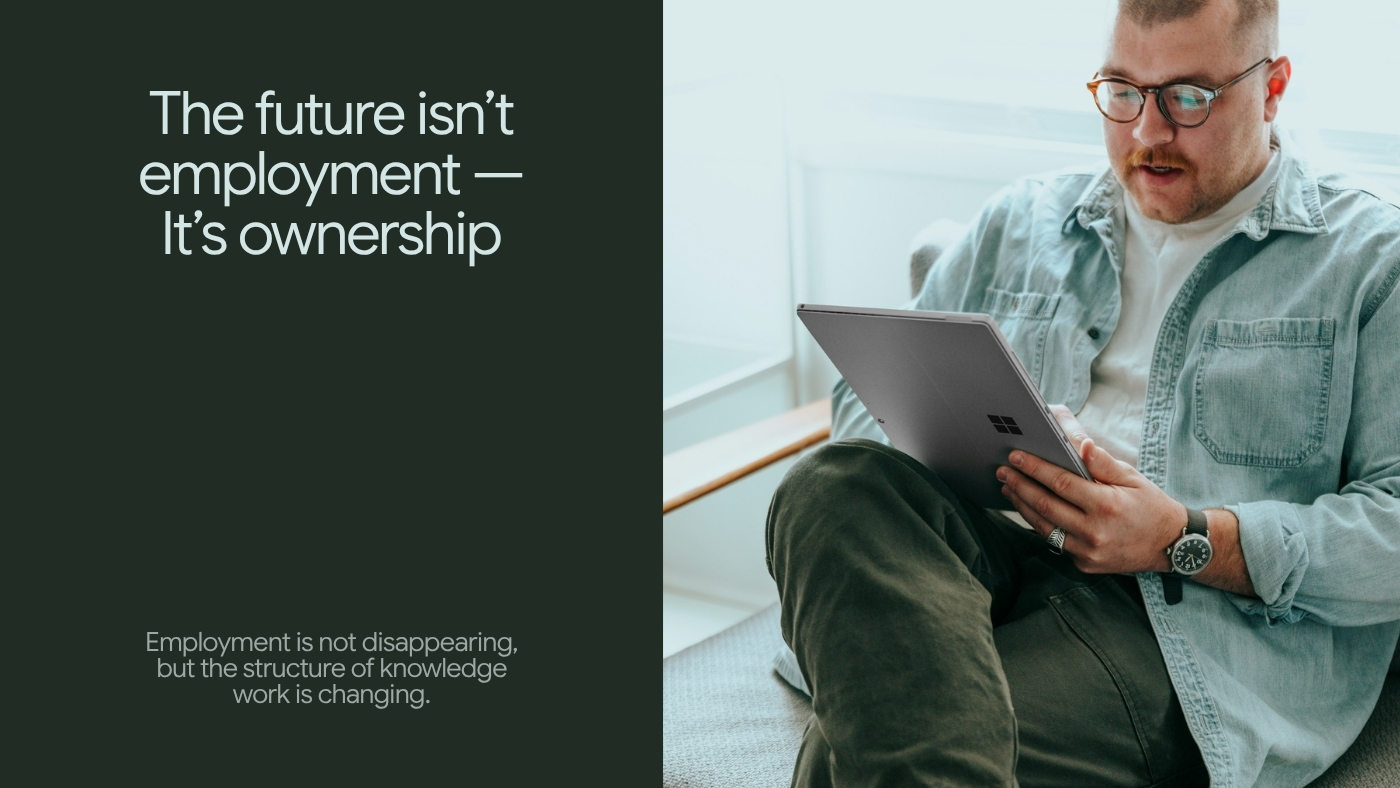
The future of work favors freelancers who adopt a business owner mindset, building systems, pricing for value, and focusing on sustainable, scalable one-person operations.

The Future of Freelance Work Belongs to People Who Think Like Business Owners
Brandset TeamBrandset Team17 min de leitura

Something important is happening to knowledge work. More professionals can now sell expertise directly, build an audience without a media company, launch a professional website without a development team, automate parts of their operations without an operations department, and use AI to handle work that previously consumed hours of administrative or production time.

The numbers deserve some care. "Freelancer" can mean anything from occasional side work to a full-time independent consultancy, which is why estimates of the freelance economy vary dramatically depending on methodology. Upwork itself has published research explaining why estimates can range from roughly one in ten workers to one in three depending on who gets counted. But among skilled knowledge workers, the direction is harder to dismiss. Upwork's Future Workforce Index, based on a survey of 2,400 U.S.-based skilled knowledge workers, found that 38% were working in freelance or independent models. Because Upwork operates a freelance marketplace, that number shouldn't be treated as a neutral census of the entire labor market — but it's still evidence of a substantial shift within the professional segment the research examined.

The bigger opportunity, however, is easy to misunderstand. Being able to work independently does not automatically mean you have built an independent business. That distinction will matter more as technology makes the first part easier.

In short:

  • Freelancing and owning a business are different skills: A talented designer can start freelancing tomorrow. Building a durable business requires answering questions about positioning, pricing, delivery, and what happens when you stop working for a week.

  • The real ceiling isn't freelancing — it's having only one lever: When personally selling another block of your time is the only way to create revenue, growth is capped by your calendar no matter how good the work is.

  • As execution gets cheaper, judgment gets more valuable: AI can generate unclear positioning faster and distribute a weak offer more efficiently. The scarce resource shifts to knowing what to sell, to whom, and what to stop doing.

  • Marketing becomes a core business function, not an occasional task: Inside a company, other systems help work reach customers. Leave the company, and most of that infrastructure stays behind — you have to build your own.

Freelancing and Owning a Business Are Different Skills

A talented designer can become a freelancer tomorrow. They need clients, a way to deliver the work, and a way to get paid. Building a durable design business requires more — who is the business for, what problem does it solve particularly well, how is the offer structured, how is it priced, where do clients come from, what happens after someone becomes interested, which parts of delivery can become repeatable, how much revenue depends directly on the founder's available hours, and what happens when the founder stops working for a week.

These questions exist whether you call yourself a freelancer, consultant, creator, solopreneur, independent professional, or agency. The label matters less than the operating model. A freelancer can absolutely be a business owner. The shift happens when the work starts being managed as a business rather than as a succession of projects.

The Real Ceiling Is Not Freelancing. It Is an Unstructured Business.

There's nothing inherently wrong with billing by the hour. Sometimes hourly pricing is exactly the right model — a client may not know the scope yet, the work may be exploratory, the engagement may require open-ended access to expertise. What becomes limiting is having only one way to create revenue: personally selling another block of your future time.

Harvard Business Review's guide for consultants and coaches makes this distinction useful. It presents several legitimate pricing models — hourly billing, retainers, productized services, and other approaches — rather than prescribing one universal method. The business question is therefore not "how do I stop charging hourly?" It's "which parts of my value really need to be tied to my time, and which do not?" A consultant may keep premium advisory work highly personal while turning implementation into a repeatable offer. A designer may charge a fixed project price for a clearly defined brand package and hourly rates for unusual additions. A coach may combine private sessions with group programs, workshops, or tools built around the same intellectual property. The goal isn't to eliminate time from the business. It's to stop making time the only lever the business has.

AI Is Changing the Economics of Being Small

AI matters here because it reduces the cost of many supporting tasks around the core expertise — research, drafting, summarization, data organization, content repurposing, administrative preparation, early-stage design exploration, coding assistance, documentation. McKinsey reports that AI use has become a mainstream part of work and is changing the composition of tasks across professions, while its broader research emphasizes that AI automates activities rather than simply replacing entire jobs.

For independent operators, that distinction is particularly interesting. They don't need AI to replace a complete employee role before it becomes economically useful. Saving two hours from five different responsibilities can matter enormously when one person owns all five. Business Insider has documented this at the level of individual operators. Solo journalist Georgia Fort reported saving roughly five to ten hours a week by using AI in parts of her social and newsletter workflow. Another solo founder, Aaron Sneed, built a collection of specialized AI agents for functions ranging from administration to finance and estimated that they saved him around 20 hours each week, while still emphasizing that high-stakes legal judgment required human professionals.

These are individual cases, not universal productivity benchmarks. They illustrate the more important point: a one-person operation can now allocate work differently. That changes what "small" can mean.

AI Does Not Remove the Need to Know What Business You Are Building

There's a trap here. When execution gets cheaper, it becomes tempting to execute more — more posts, more landing pages, more automations, more emails, more products, more channels, more AI agents. More output can still produce a worse business. If positioning is unclear, AI can generate unclear positioning faster. If the offer is weak, automation can distribute the weak offer more efficiently. If the customer is poorly defined, AI can create enormous quantities of irrelevant content for them.

The scarce resource shifts. As execution becomes easier, judgment becomes more valuable — what should we sell, to whom, what should we stop doing, which customer problem deserves our attention, which part should remain human, which process is stable enough to automate, what's genuinely differentiated here. That is business ownership.

The First Upgrade: Stop Selling "What You Do"

Freelancers often describe themselves through capabilities — graphic designer, copywriter, marketing consultant, web developer, fractional CMO. Those labels tell a potential buyer what category of person they're speaking to. They don't necessarily explain why they should hire that person.

A stronger business begins with the intersection of customer, problem, outcome, and approach. "Web designer" becomes "I build conversion-focused websites for independent financial advisors who have outgrown referral-only growth." "Email marketer" becomes "I build lifecycle email systems for small SaaS teams that have acquisition but weak activation and retention." The more specific version does something useful — it makes the business easier to understand, which helps marketing, referrals, pricing, deciding what content to publish, and saying no to work that doesn't fit. Specificity isn't about making the addressable market artificially tiny. It's about becoming easy to categorize in the mind of the customer.

The Second Upgrade: Turn Services Into Offers

A service describes a capability. An offer describes a buying decision. Consider "marketing consulting" versus "30-Day Positioning Sprint: customer research, competitive positioning, messaging architecture, and a final positioning document for B2B SaaS founders preparing to relaunch their website." The second version gives the client more information — who it's for, what's included, what outcome is expected, how the engagement works, what boundaries exist.

This is where productized or packaged services become useful. They're not inherently better than custom consulting. They reduce ambiguity when the underlying problem is repeatable enough to standardize. Harvard Business Review includes productized services alongside hourly and retainer structures as one of several ways independent consultants can package and price expertise.

For a solo business, repeatability has another advantage: every delivery teaches you something that can improve the next one. The kickoff gets clearer, the questionnaire gets better, the templates improve, common problems become predictable, parts of delivery can be automated. Margins can improve without simply working faster under pressure. That's operational leverage.

The Third Upgrade: Build Recurrence Where the Customer Has a Recurring Problem

Recurring revenue is attractive. That doesn't mean every project should be forced into a retainer. A logo project doesn't automatically create a monthly logo problem. A one-time immigration consultation doesn't necessarily require an endless subscription. Recurring revenue works when recurring customer value exists underneath it — a website studio may provide ongoing optimization after the build, an SEO consultant may monitor and improve organic performance continuously, a financial advisor has an ongoing relationship by definition, a marketing strategist may provide monthly planning and review.

The important question is: what problem continues after the initial project ends? Build recurrence around that. Not around your desire for predictable billing.

The Fourth Upgrade: Turn Knowledge Into Assets

One of the most powerful transitions for an independent professional happens when expertise stops existing only inside conversations and deliverables. A repeated explanation can become an article. A repeated audit can become a checklist. A repeated framework can become a template. A repeated client process can become a workshop. A methodology can eventually become software.

This doesn't mean every consultant should launch a course. It means recognizing that expertise can create assets. Business Insider profiled career coach Julia Starr, whose coaching business had historically been constrained by her own availability. She eventually turned part of her methodology into an AI-supported application, creating a lower-priced way for customers to access part of her approach without requiring a private coaching hour every time. That's one person's model — but the strategic pattern is more widely useful: service work produces knowledge, and knowledge can become reusable intellectual property. That intellectual property can improve delivery, marketing, differentiation, and eventually revenue.

The Fifth Upgrade: Separate Expertise From Operations

Every solo business contains two kinds of work. There's work only you should do — judgment, creative direction, high-value client conversations, final decisions, specialized expertise, relationship building. And there's work that simply needs to get done — scheduling, follow-up, formatting, initial research, document preparation, data organization, routine reporting, publishing, administrative communication.

The mistake is treating both categories as equally dependent on the founder. The objective of systems is to reduce the founder's involvement in the second category so they can spend more time in the first. AI expands what can be systematized. No-code expands it further. Templates, automation, and clear processes all help. Eventually, people may help too. Thinking like a business owner doesn't mean doing everything alone forever. It means being deliberate about what requires you.

You Do Not Need a Team to Start Building Systems

Founders often postpone systems because the business feels too small. There are only three clients — why document onboarding? The newsletter has only 200 subscribers — why create an editorial process? There aren't enough leads — why organize the CRM? That logic works until growth arrives, and then the business suddenly needs systems at exactly the moment there's the least time to build them.

A small system can be simple: a reusable proposal template, a defined onboarding checklist, one place for customer information, a standard project kickoff, a clear folder structure, a weekly marketing routine, a follow-up workflow, an editorial backlog. The purpose isn't bureaucracy. It's reducing how often the business has to solve the same operational problem from scratch.

Independent Work Is Becoming More Serious, Not Less

The stereotype of freelancing as temporary or marginal work is increasingly difficult to reconcile with the skilled independent economy. Upwork's research found that more than one in three skilled U.S. knowledge workers in its sample were working independently, spanning functions such as software, marketing, consulting, writing, and design — and identified a specific "freelance business owner" segment managing portfolios of clients and projects rather than treating freelancing only as occasional task work.

MBO Partners' long-running State of Independence research offers another indication of professionalization: its latest published study reported 5.6 million U.S. independent workers earning more than $100,000 annually. Because MBO also operates in the independent-work industry, its research should be understood in that context, but the long-running survey still provides evidence that independent work includes a meaningful high-income professional segment.

McKinsey reached an important conclusion much earlier: independent work is not one phenomenon. It includes people working independently by choice and people doing so from necessity, and experiences differ substantially between the two. That distinction remains useful. Independent work should not be romanticized. There's no employer automatically providing salary, benefits, pipeline, training, technology, management, administrative infrastructure, or career development. You inherit responsibility for all of it. Freedom and responsibility arrive together.

Marketing Becomes a Core Business Function

One of the biggest changes in going independent is that good work is no longer enough by itself. Inside a company, other systems help work reach customers — a brand, a website, a sales team, demand generation, PR, partnerships, a customer database, an existing reputation, distribution. Leave the company, and most of that stays behind.

Independent professionals need their own distribution. That doesn't mean becoming a full-time content creator. It means building enough marketing infrastructure that potential customers can discover you, understand what you do, trust your expertise, stay connected when they're not ready to buy, and take the next step when they are. For most solo knowledge businesses, that can be surprisingly compact.

The best marketing asset for an expert is often evidence of expertise — explaining something customers misunderstand, taking a position, showing your process, breaking down a decision, answering the question you hear on every sales call. This type of content does more than generate reach. It reduces uncertainty. A potential client can understand how you think before speaking to you, which makes marketing and sales less dependent on claims like "high-quality service" or "results-driven approach" that anyone can write. Useful thinking is harder to fake.

Build an Audience You Can Reach Again

Discovery is valuable. Repeat access is more valuable. A visitor who reads one article and disappears may never encounter you again. A subscriber has explicitly asked to continue the relationship. That's why email remains particularly useful for independent businesses.

The important distinction isn't that an email list is literally "owned" in the sense that nothing mediates it — mailbox providers still control delivery and sender requirements. The advantage is that the business has a direct, permission-based relationship with the subscriber rather than depending entirely on an algorithm to decide whether a future post appears in their feed. For someone with a long sales cycle, that continuity matters. A potential client may follow your work for months before they need what you sell.

Make Referrals Easy by Being Easy to Explain

Imagine a former client trying to refer you. Version A: "You should talk to Maya. She does marketing and branding and websites and some strategy stuff." Version B: "Talk to Maya. She helps independent consultants turn their expertise into a clear brand and website." Version B travels. The referral source doesn't need to reconstruct the business before making the introduction.

Good positioning creates compression — someone else can explain who you help and what you help them do. That matters disproportionately for one-person businesses because trust often moves through relationships faster than advertising budgets can manufacture it.

Consistency Matters More Than Performing Marketing in Bursts

A common independent-business pattern: no marketing while client work is busy, panic when the pipeline slows, publish intensely, win clients, stop marketing because client work is busy again, repeat. The problem is structural — marketing is being activated only after the business needs the result.

A healthier model keeps a modest level of activity running continuously: one useful article, one newsletter, one follow-up routine, one consistent place where leads can understand the offer. The exact cadence matters less than designing one that survives a busy month. A marketing system that only works when you have nothing else to do is not much of a system.

The Best Solo Business Is Not Necessarily the Biggest One

Entrepreneurship culture often treats headcount as proof of progress. For many independent professionals, that's the wrong objective. You may want employees. You may want a 50-person agency. You may want to remain one person. All are legitimate. Technology makes the third option more interesting than it used to be because the amount one person can coordinate is changing.

McKinsey's work on AI describes emerging organizations where humans increasingly work alongside AI agents and automated systems, while still emphasizing the need to redesign work and retain human judgment where it matters. The question becomes: what is the smallest organization capable of creating the business and life you want? That's more useful than assuming growth always means adding people.

Protect the Reason You Went Independent

There's an uncomfortable failure mode in freelancing. You leave employment because you want more autonomy. Then you build a business where every customer depends on you, every sale depends on you, every email depends on you, every project decision depends on you, every invoice depends on you, and every day off creates a backlog. You become indispensable to a system you own. That's still a constraint.

Business ownership should gradually create options — the ability to raise prices, decline poor-fit work, take time away, shift revenue models, introduce new offers, reduce reliance on one client, and choose where personal involvement creates the most value. Those options are a better measure of independence than simply having no employer.

Think Like an Owner Before You Feel Ready

You don't need a large business before adopting owner-level thinking. You can start with a $2,000 freelance project and ask: why did this customer buy? Which part of the process repeated? What did I create that could be reused? What question came up several times? What took time without requiring much judgment? What should become a template? Could the next client buy a clearer version of this offer? Is there a natural ongoing problem after delivery? Where did this client discover me, and how can I make that discovery path more reliable?

Those questions gradually change the business. Project by project. System by system.

Where Brandset Fits

One-person businesses eventually run into a marketing version of the same problem: too much of the operation depends on the owner coordinating separate tools. Brandset brings Website Builder, Landing Pages, Forms, Popups, CRM and lead management, Email Marketing, Workflows, content capabilities, Link in Bio, and the Brand Center into the same broader marketing environment. The Brand Center keeps shared information such as visual identity, voice, positioning, audience context, products, and services closer to the work, so marketing doesn't need to begin from a blank understanding of the business every time.

For an independent operator, that's the larger idea behind Brandset: reduce the amount of time spent rebuilding context and coordinating marketing infrastructure so more attention can stay on the decisions that actually require the owner.

Tools cannot turn a freelancer into a business owner. They can remove some of the operational work that keeps one trapped acting like the entire company. The rest is business design.

Start your 7-day free trial →