
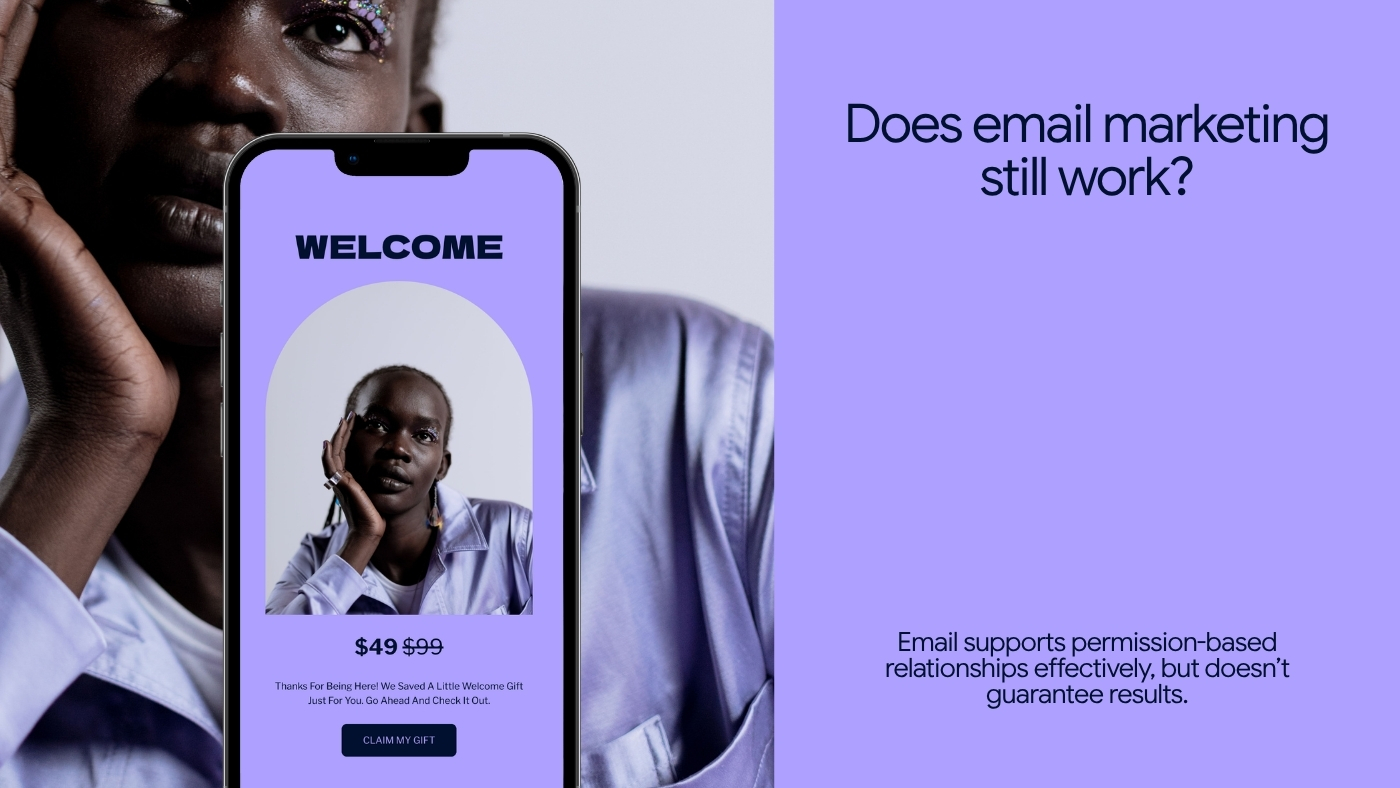

Does Email Marketing Still Work?

Email marketing works best for nurturing existing relationships, not discovery. Success depends on permission, relevance, segmentation, and strong technical infrastructure.

Does Email Marketing Still Work?
Brandset TeamBrandset Team19 min de leitura

Yes. But that answer is almost useless without defining what "work" means.

Does email work for getting a business discovered by people who have never heard of it? Usually, that's not its strongest job. Does it work for continuing a relationship after someone subscribes, downloads something, buys, requests information, or otherwise chooses to hear from the business? That's where email becomes much more interesting. Does every newsletter, promotional campaign, or automation produce meaningful revenue? Of course not.

Email works when the relationship, audience, message, timing, technical infrastructure, and next step make sense together. When those pieces are missing, sending more email rarely fixes the problem.

In short:

  • Email has a different job than search, social, or paid acquisition: It usually enters the journey after someone has already done something — visited, bought, downloaded, registered. It's not primarily a discovery channel.

  • "Owned channel" needs a qualification: Gmail, Yahoo, spam filters, and authentication standards all mediate whether a message reaches someone. Email is better described as a permission-based relationship that's less algorithm-dependent than social — not a channel you fully control.

  • List size is one of the easiest metrics to overvalue: A list of 25,000 people who barely remember subscribing can underperform a list of 8,000 who understand exactly why they're on it.

  • "Email works" and "our email program works" are different statements: The first describes a channel with useful structural characteristics. The second has to be earned through permission, relevance, deliverability, and infrastructure that actually holds together.

Email Has a Different Job From Social, Search, and Paid Acquisition

Search helps people find answers and businesses when they're actively looking. Social platforms help ideas travel through networks and recommendation systems. Paid media buys distribution. Email usually enters the customer journey later — someone has already visited the website, bought a product, downloaded a guide, created an account, registered for an event, joined a newsletter, or requested information. That action gives the business an opportunity to continue the relationship directly through an inbox.

"Directly" needs an important qualification. Email is sometimes described as an "owned channel," but businesses don't control the infrastructure around it completely. Gmail, Yahoo, Outlook, Apple Mail, email service providers, spam filters, authentication standards, and recipient behavior all influence whether and how a message reaches someone. Google, for example, imposes explicit authentication, infrastructure, complaint-rate, formatting, and unsubscribe requirements on senders delivering email to personal Gmail accounts. Email is better understood as a direct, permission-based relationship that's less dependent on algorithmic distribution than most social channels, while still being mediated by inbox providers. That distinction is enough to make it valuable.

The Advantage Begins With Permission

A healthy email program begins with a fairly simple event: someone decides they want to hear from you. Google recommends that subscription senders obtain clear opt-in, confirm addresses, set expectations, and avoid sending messages to people who didn't sign up. Yahoo similarly recommends confirmed opt-in and clear expectations about what subscribers will receive and how often.

That creates a different starting point from interruptive advertising. The subscriber has already expressed some degree of interest — though the strength of that interest can vary dramatically. Someone joining a product waitlist is different from someone subscribing to a weekly essay. A customer asking for product updates is different from someone downloading a checklist. A webinar registrant is different from someone who checked an unrelated box during checkout. Good email marketing preserves those differences. Poor email marketing immediately collapses them into "newsletter list" and sends everyone the same thing.

Email Works Better When the Signup Promise Is Clear

Every signup creates an expectation. "Join our newsletter" versus "Get one practical email every Friday about running marketing with a team of one." The second tells the subscriber what they're agreeing to — which matters because email relevance begins before the first campaign is created. Google's bulk email guidance recommends setting expectations around both content and frequency, particularly because consistently sending messages recipients don't find useful can increase unsubscribes and spam complaints.

A good signup should make several things reasonably clear: what will I receive, why might it be useful, how often should I expect it, who is sending it, and — if a lead magnet is involved — what happens after I download it. The business is establishing the rules of the relationship. Everything that follows should make sense within them.

The List Is the Beginning, Not the Goal

Subscriber count is one of the easiest email metrics to understand, which makes it easy to overvalue. A list of 25,000 people who barely remember subscribing can be less useful than a much smaller audience that clearly understands the relationship and consistently finds the communication relevant. The better question isn't "how big is the list?" It's "who is on it, why did they join, and what do they expect next?" This is where segmentation starts.

Segmentation Preserves Context

Consider four subscribers: one downloaded a pricing guide yesterday, one has been a customer for two years, one registered for a webinar about email automation, and one joined a general newsletter six months ago. They all have email addresses in the same database. That doesn't make them the same audience. Their context should change the content, the offer, the timing, the amount of explanation needed, and the appropriate CTA.

McKinsey's personalization work emphasizes using customer context and meaningful signals across the customer journey rather than relying only on broad audience categories. Useful segmentation doesn't require hundreds of rules — start with distinctions that genuinely change what someone should receive: signup source, expressed interests, customer status, lifecycle stage, explicit preferences, meaningful behavior. The purpose is relevance, not segmentation for its own sake.

Behavior Helps, but It Does Not Read Minds

Modern email tools can record useful events — someone clicked, visited, downloaded, purchased, submitted, registered. Those events can improve marketing decisions. Problems start when an observable event is converted into a psychological certainty. A pricing-page visit doesn't prove that someone is ready to buy. One link click doesn't prove high intent. A guide download doesn't mean someone wants every sales email related to the topic.

Treat behavior as evidence. Look for context and patterns. A subscriber who downloaded a buying guide, clicked a product email, returned to pricing, and requested a consultation has provided much more information than someone who accidentally clicked one link. Email becomes more useful when the system can preserve that distinction.

Campaigns and Automations Solve Different Problems

A campaign is useful when the business has something relevant to communicate at a particular moment — a newsletter, a launch, a sale, an event, a customer announcement, a new article. Automation handles situations that recur predictably: someone subscribes, requests a resource, becomes a customer, completes a relevant action, or reaches a particular lifecycle state. This difference matters because a healthy email program usually needs both. Campaigns allow businesses to respond to what's happening now. Automations reduce the need to manually handle the same customer moment hundreds of times.

Welcome Email Is an Orientation Problem

When someone subscribes, they have several immediate questions — did the signup work, where's the thing I requested, who's emailing me, what should I expect next, is there anything useful I should do now? The welcome experience should answer those questions. That can be one email, or a short sequence when the relationship requires more context. It doesn't need to become an excuse to immediately send five sales emails. The goal is orientation. A clear beginning makes future email easier to understand.

Email Becomes More Valuable Across the Customer Lifecycle

Many businesses think about email mainly as acquisition — get the address, nurture, make the sale. But the customer relationship doesn't end at checkout. After someone buys, new communication opportunities appear: onboarding, education, product use, support, renewal, replenishment, cross-sell when relevant, new product announcements, feedback, retention, reactivation. The appropriate mix depends on the business — a SaaS product, ecommerce brand, consultant, restaurant, and one-time professional service all have very different lifecycle dynamics. This is why the question "does email work?" cannot have one universal ROI answer. The economic role of email depends on the relationship the business is capable of having with its customers.

Some businesses naturally create repeated customer moments — software, subscriptions, retail, education, professional services, memberships, events, financial services, media, businesses with ongoing product usage or recurring needs. In those models, email can continue helping the customer long after acquisition. For a business where the customer genuinely buys once and has little reason to return, the opportunity is different — email may still support referrals, education, reviews, related services, and occasional reactivation, but a business shouldn't invent a lifecycle that doesn't exist merely because lifecycle email is fashionable. Marketing should reflect the economics of the business.

Email Is Usually a Poor Substitute for Discovery

Suppose a business launches today. It has no customers, no audience, no meaningful website traffic, no subscribers. Email marketing cannot magically create distribution from an empty list. The business first needs discovery — through search, social, partnerships, events, communities, paid acquisition, PR, outbound sales where appropriate, referrals, or existing relationships. Email then gives interested people a way to stay connected. This is an important limitation. Email can compound an audience relationship. It cannot compound an audience that doesn't exist.

Bought Lists Solve the Wrong Problem

When audience growth is slow, buying contacts can look like a shortcut. It creates a larger database immediately. It doesn't create permission. Google explicitly tells senders not to purchase email addresses and not to send messages to people who didn't sign up. Yahoo similarly advises opt-in and warns that unsolicited commercial email can damage sender reputation.

There's also an important legal distinction. In the United States, CAN-SPAM doesn't create a universal prior-consent requirement for all commercial email. The FTC nevertheless warns that purchased lists can contain addresses acquired improperly or people who have already opted out, while commercial messages remain subject to requirements around accurate sender information, non-deceptive subject lines, physical address information, and opt-out rights. So "legal to send under some circumstances" and "good email marketing strategy" are different questions. For a permission-based email program, purchased lists work against the relationship you're trying to build.

Deliverability Is Part of Marketing

An excellent email that consistently lands in spam is not an excellent email program. For personal Gmail accounts, Google requires all senders to use SPF or DKIM, along with valid DNS, TLS, appropriate message formatting, and acceptable complaint levels. Senders above Gmail's bulk threshold face additional requirements including SPF and DKIM, DMARC, From-domain alignment, and one-click unsubscribe for marketing and subscribed messages. Yahoo has similar requirements around authentication, complaints, DNS, and unsubscribe for bulk senders.

You don't need to become an email infrastructure engineer to run a small business. You do need to recognize the basics: SPF helps receivers understand which systems are authorized to send on behalf of a domain, DKIM provides a cryptographic signature receivers can validate, and DMARC connects authentication with domain alignment and lets domain owners publish a policy for authentication failures. None guarantees inbox placement. They form part of the foundation legitimate sending infrastructure is expected to have.

Subscribers can also tell mailbox providers directly that they don't want your mail, and that feedback matters more than most vanity metrics. Google advises senders to keep user-reported spam below 0.1% and avoid reaching 0.3% or higher, noting that complaint rates above 0.1% can already negatively affect inbox delivery for bulk senders. Yahoo requires spam complaint rates below 0.3%. These are operational thresholds, not benchmarks to approach comfortably. If complaints increase, investigate the relationship — did these recipients opt in, did they expect this message, was the sender recognizable, has frequency changed, does the content match the signup promise, is unsubscribe easy? A high-performing campaign that produces unusual complaint behavior may be borrowing against future deliverability.

Making leaving easy is part of the same discipline. An unsubscribe doesn't mean the email program failed — it means one person no longer wants that particular relationship. Google requires one-click unsubscribe for applicable subscription messages and says requests should be processed within 48 hours. Yahoo similarly requires easy unsubscribe for bulk marketing mail and asks senders to honor requests within two days. U.S. CAN-SPAM rules give recipients the right to opt out of commercial email and require covered senders to honor opt-out requests within the legal timeframe. Hiding the link doesn't preserve a healthy subscriber. It may simply redirect dissatisfaction toward the spam button.

Open Rate Does Not Mean "People Who Read My Email"

Open rate is still prominently displayed by most email platforms. Interpret it carefully. Apple's Mail Privacy Protection can download remote content in the background independently of whether someone interacts with the email — since conventional tracking pixels depend on remote content loading, this can generate recorded opens that don't correspond to a deliberate human open. Google is even more explicit about the limitation: Gmail says it doesn't track sender open rates and cannot verify the accuracy of open-rate data reported by third parties. So a 48% open rate doesn't mean 48% of recipients read the email. It's a directional metric with significant limitations.

Measure the Action the Email Exists to Produce

Suppose an email exists to drive registrations — the business metric is registrations. Suppose it exists to sell a product — the metric is purchase behavior. Suppose it's a founder newsletter designed to maintain a relationship with prospective clients — useful signals might include relevant clicks, replies, qualified inquiries, and long-term subscriber behavior. Suppose it exists to help customers activate a product feature — the useful metric may live inside the product, not the email dashboard. Email metrics should follow the job of the message.

A click requires more deliberate behavior than a tracked open, which makes it useful — though it doesn't make every click equally valuable. A subscriber clicking "View pricing" is doing something different from clicking "Read our privacy policy." Don't turn "CTR increased" into "email marketing improved" without asking what people clicked and what happened next.

If the email exists to produce a purchase, a trial, a registration, a booked call, a download, or an application, a completed version of that action is usually more useful than the click that preceded it. But even conversion has limits — a lead-generation campaign can generate many low-quality leads, a discount can drive first purchases that never repeat, a free trial can produce many signups and little activation. Email measurement becomes more useful as it moves closer to the eventual business outcome.

Revenue Attribution Is Useful, Not Omniscient

Imagine this journey: a subscriber receives a newsletter, clicks an article, returns through Google four days later, visits pricing, leaves, a colleague sends them a recommendation, they return directly, and purchase. An attribution system can assign credit according to whichever model it uses. That doesn't mean it reconstructed the customer's reasoning. Revenue attribution is useful for understanding patterns. Treating attributed email revenue as perfect causal truth can create false precision. The same caution applies to broad industry ROI statistics — an average cannot tell you what email will return for your business, your list quality, your margin structure, your lifecycle, your acquisition source, your offer, and your attribution model. The useful evidence is your own system over time.

The Real Test Is Whether Email Changes Customer Behavior

Imagine two email programs. Program A has 50,000 subscribers, a respectable-looking open rate, and regular campaigns — but little evidence that email changes purchases, activation, retention, registration, or other business outcomes. Program B has 8,000 subscribers, clear segments, useful customer communication, relevant automations, meaningful click behavior, trackable registrations and purchases, replies, and low complaint behavior. Which one "works"? Subscriber count doesn't answer that. Open rate doesn't answer that. The business outcome does.

Email Often Underperforms Because the Destination Is Weak

Sometimes the email did its job — people clicked. Then the landing page didn't. The offer changed, the form broke, the mobile experience was poor, the checkout added unexpected friction, the page used different language from the email, the registration form asked for too much. The campaign gets blamed because the conversion dashboard begins with email, but the customer experienced a journey. Review the complete path: email → landing page → form → checkout or next step → confirmation → follow-up. A weak destination can make a strong email look ineffective.

There's another class of problem readers never see. A form submits but doesn't create the right contact. A contact reaches the CRM without useful source data. An automation triggers for the wrong people. A customer keeps receiving prospect nurture. An unsubscribe state fails to propagate correctly. A campaign uses stale segmentation. The business looks at disappointing numbers and concludes "email isn't working" — but the actual issue may be operational. This is why email should be evaluated as part of a system rather than only as a creative asset.

Consider this full journey: website → landing page → form → lead → CRM → segment → email → workflow → conversion. Each arrow represents a handoff. If those handoffs preserve context, the business can communicate more intelligently. If they don't, the customer experience becomes fragmented. The form knows why someone signed up — the email system should ideally have enough context to respect that. The CRM knows whether someone became a customer — future communication should reflect it. The workflow knows an intended sequence — it should stop or change when the customer's state changes. This is where the quality of the surrounding infrastructure begins influencing the quality of email itself.

Personalization Needs Restraint

Email data can make communication more relevant. It can also make communication uncomfortable. Harvard Business Review has highlighted this tension: consumers can value personalization while remaining concerned about how companies collect and use personal information. Its recommendations emphasize clear privacy and opt-in practices, human-centered communication, and continuous learning rather than treating more data as automatically better marketing.

Use customer context because it improves the relationship, not because the database happens to contain it. A useful test: would the subscriber reasonably understand why we know this, and would they expect us to use it this way? Does it materially improve the message? If not, leave it alone.

Email Marketing Probably Is Not Your Immediate Priority When...

There are situations where email shouldn't receive most of the marketing attention yet. If you have almost no audience, discovery is the bottleneck — work on discovery first, and email can retain future interest once people arrive. If your signup promise is unclear, fix why someone should subscribe before optimizing the email template. If your offer isn't validated, a sophisticated lifecycle program can't rescue something customers don't want. If your sending infrastructure is broken, fix authentication, list problems, deliverability, and obvious workflow failures first. If you can't identify a useful ongoing relationship, don't manufacture weekly email simply because marketers say every business needs a newsletter. And if you're sending mainly to people who didn't ask for the communication, fix the audience strategy — tactical optimization comes afterward.

Email Is Working When It Does the Job You Gave It

For a newsletter, success may mean building an audience that repeatedly engages with useful ideas and eventually creates opportunities. For ecommerce, it may mean purchases, repeat purchases, education, and product discovery. For SaaS, it may mean activation, adoption, expansion, and retention. For consultants, it may mean remaining useful and recognizable during the long period between initial discovery and a buying decision. For a local business, it may mean reservations, repeat visits, announcements, or seasonal demand. The jobs differ. The principle doesn't: email works when it changes the relationship or behavior in a way that matters to the business and the subscriber.

A Practical Diagnostic: Why Isn't Email Working?

If your email program consistently underperforms, review it in this order:

  1. Audience — did these people actually ask to hear from you?

  2. Signup promise — do they know what they subscribed to?

  3. Relevance — does the communication reflect their context?

  4. Offer — is there something genuinely worth acting on?

  5. Lifecycle — are prospects, customers, and other states being treated appropriately?

  6. Deliverability — is the technical foundation healthy?

  7. Frequency — does the cadence make sense for this audience and relationship?

  8. Message — is the email easy to understand?

  9. Destination — does the post-click experience continue the promise?

  10. Automation — are triggers, conditions, and transitions working as intended?

  11. Measurement — are you evaluating the business outcome or only dashboard proxies?

This order matters. Changing the subject line before answering the first five questions is usually premature optimization.

So, Does Email Marketing Still Work?

Yes. Its role is simply more specific than the broad ROI headlines suggest.

Email is exceptionally useful when a business needs to continue a permission-based relationship after initial discovery. It can help turn a visitor into a subscriber, a subscriber into an informed prospect, a new customer into an activated customer, a customer into a repeat customer, and an occasional reader into someone who trusts the business enough to contact it when the need appears.

It can also fail badly when the audience never wanted the email, the signup promise is vague, the list is treated as one homogeneous group, the sending infrastructure is unhealthy, the messages are irrelevant, the destination breaks the journey, or the business optimizes proxies instead of outcomes.

That's why "email works" and "our email program works" are two different statements. The first describes a channel with useful structural characteristics. The second has to be earned.

Where Brandset Fits

For small businesses, much of the difficulty appears between the systems surrounding email. A landing page captures interest. A form collects information. The CRM preserves the relationship. Email continues it. Workflows handle repeatable moments. The Brand Center helps keep communication consistent with the same voice, positioning, audience context, colors, typography, products, and services used elsewhere. Brandset brings those capabilities into the same broader marketing environment.

That doesn't guarantee a relevant message. It doesn't decide what customers care about. It doesn't replace consent, strategy, positioning, or good judgment. It reduces the amount of infrastructure a small team has to coordinate before those decisions can become working marketing.

Email marketing still works. The useful question is whether the system around yours gives it a fair chance to.

Start your 7-day free trial →